In this guide
- Separate sentences before checking them
- Use five useful columns
- Assign the source a job
- Separate evidence strength from publication risk
- Review a hypothetical row
- Handle a claim that cannot be shortened safely
- Run the handoff
- Keep the register proportionate
- Worked example: three claims, three decisions
- Reusable work card
- Sources and scope
- Continue with a different task
Create a claim register that stops a general product page becoming proof of specific employee entitlements.
Separate sentences before checking them
A sentence such as “The card is free, transfers instantly and works for everyone” contains several claims with different evidence needs. Treating the whole sentence as one reviewed item hides the weakest part. Start a small register in the employer’s approved workspace with one row for each factual proposition. The register is an editorial aid; it should contain public claims and references, not employee account information.
Use five useful columns
Record the proposed wording, intended audience, supporting document, limitation and reviewer. Add a source-check date and the next event that should trigger review. The audience column matters: a statement intended for one employer program should not drift into an all-employee handout. A limitation belongs next to the claim, where a later writer will see it, rather than in an unrelated notebook.
Assign the source a job
A current brand page can support a naming statement. A program agreement can support a term only if it applies to the intended readers. Consumer guidance can explain a general right without proving the employer’s implementation. Give an unsupported claim the status “needs evidence”; do not mark it false merely because the writer cannot yet verify it. The useful outcome is a publication decision, not a verdict on a provider.
Separate evidence strength from publication risk
Two unsupported sentences can deserve different handling. An unverified decorative description may be easy to remove without affecting the reader’s task. An unverified instruction about when an employee must act can change behaviour and needs immediate attention. Add a practical consequence column when the register is used for a larger handout: what would a reader do differently if this sentence were wrong? That question helps the reviewer prioritize without inventing a numerical legal-risk score. It also prevents a team from spending the whole meeting polishing low-consequence wording while a payment-timing promise remains unexamined. Keep the consequence description specific and tied to the proposed audience.
Review a hypothetical row
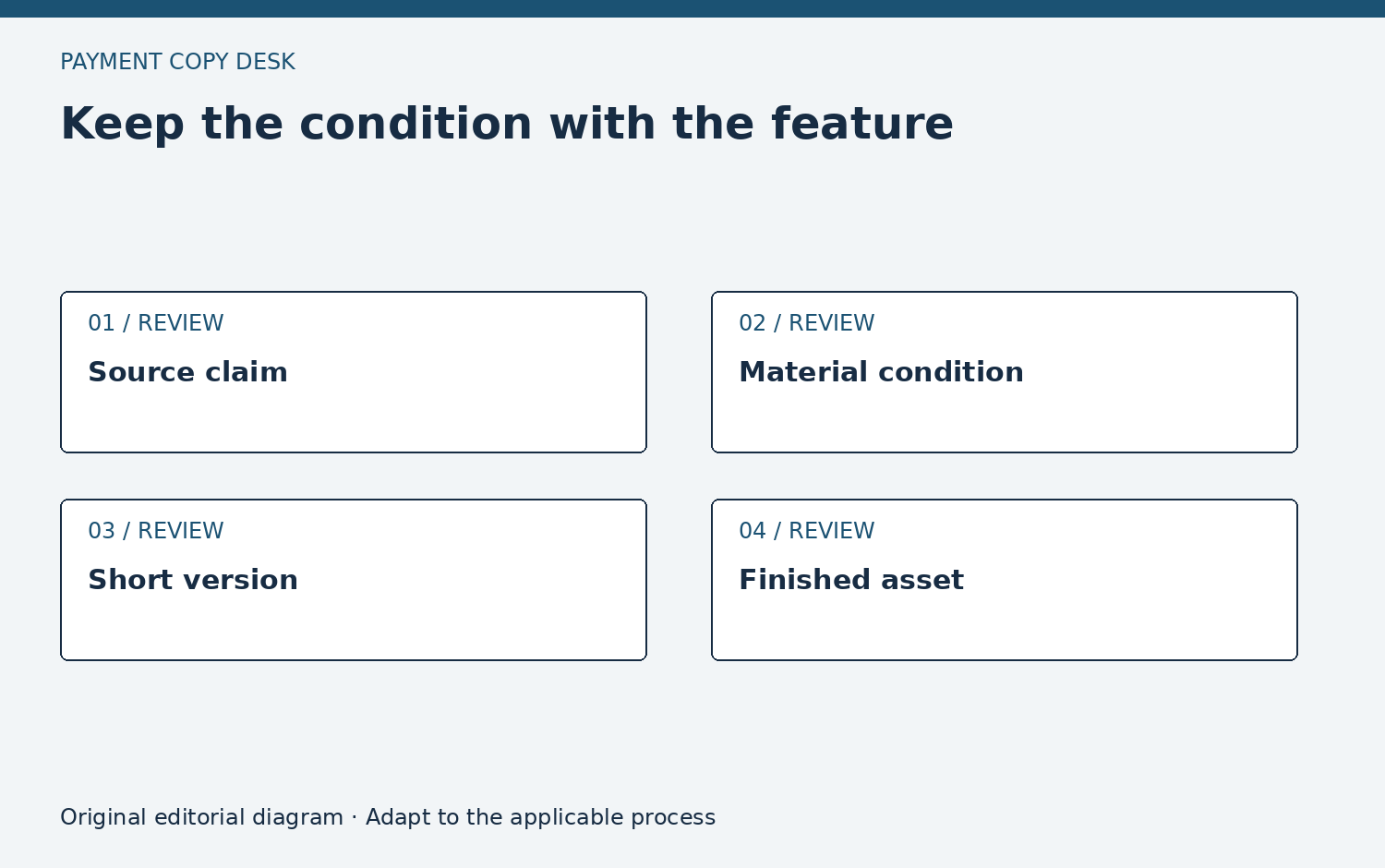
An HR team wants to mention bank transfers. Its source says a feature is conditional, but its draft drops the condition. The row should preserve the condition, identify the affected program and ask the program owner for current wording. If that evidence is unavailable, the handout can direct readers to their applicable terms instead of promising availability.
Handle a claim that cannot be shortened safely
Sometimes the approved claim is too conditional for a poster or chat preview. The solution is not to detach its limitations. Change the job of the short asset: it can direct employees to the applicable document or invite a question through the employer’s established channel. Record that decision in the register so a later writer understands why the poster does not repeat the feature claim. The longer guide can retain the full explanation, provided its evidence supports it. This creates a deliberate relationship between short and long formats rather than treating every communication as a smaller copy of the same sentence. The register becomes useful editorial memory, not just a list of links.
Run the handoff
Before another writer takes over, sort the register by unresolved items. Resolve or remove high-consequence claims before publication. Retain the final wording alongside the evidence so a later review can see whether a qualification disappeared during design or translation. A checked source and an approved sentence are separate records.
Keep the register proportionate
Do not turn every connective word into a compliance ticket. Prioritize fees, timing, access, eligibility, mandatory actions and account protections. Those claims can change what a reader does with wages. The public sources linked here establish the need for scope; this register is our own suggested editorial workflow.
Worked example: three claims, three decisions
A fictional HR team is preparing an orientation notice for one workplace program. Its first draft reads: “Fintwist is now Corpay Prepaid, every employee can transfer money instantly, and everyone should activate a new account.” The team has only the current public homepage and its own existing orientation instructions. The sentence sounds coherent, but the evidence does not support treating its parts as one claim.
Row A concerns the name. The public provider statement supplies evidence for that limited point. The proposed employee wording becomes: “The provider’s current public website uses the Corpay Prepaid name.” The register records the page and check date. It does not attach a new-account instruction to the naming fact.
Row B concerns transfer availability and timing. The team has not established the applicable program, audience or timing terms. Its decision is hold, with the question: “Which current program document supports the proposed availability and timing statement for this group?” Removing the word instantly would not by itself resolve the universal availability claim.
Row C concerns a required activation. The existing employer instruction does not establish that a brand announcement requires a new account. Its decision is remove from this notice. If an authorized program owner later supplies a specific migration instruction, that instruction gets its own audience, effective period and review rather than being smuggled into the naming row.
The resulting notice is shorter than the draft and better supported. The team retains two unresolved or removed rows internally so the next designer cannot accidentally restore them. Completion is evidence-linked wording ready for the employer’s review, not a guarantee that a public statement establishes every employee’s private account status.
Reusable work card
Use these prompts in your organization’s approved process. They request no private account information and do not authorize a payment or account change.
- Give the proposed sentence a stable reference so design and translation reviewers can discuss the same claim.
- Record whether the evidence is public, program-specific or an approved employer instruction; do not merge those categories.
- Identify the reader group and period before deciding whether a source applies to the proposed wording.
- Write the condition in the same row as the benefit or feature it limits.
- Give unresolved claims an owner and a question that can be answered with an applicable document.
- Compare the final published sentence against the approved row after layout, export and any last-minute edits.